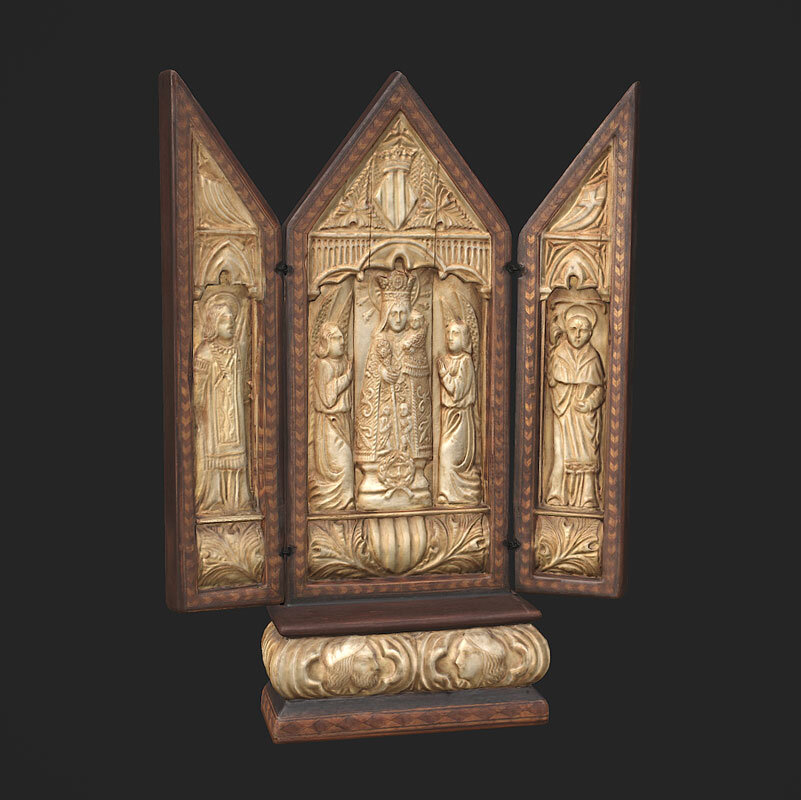
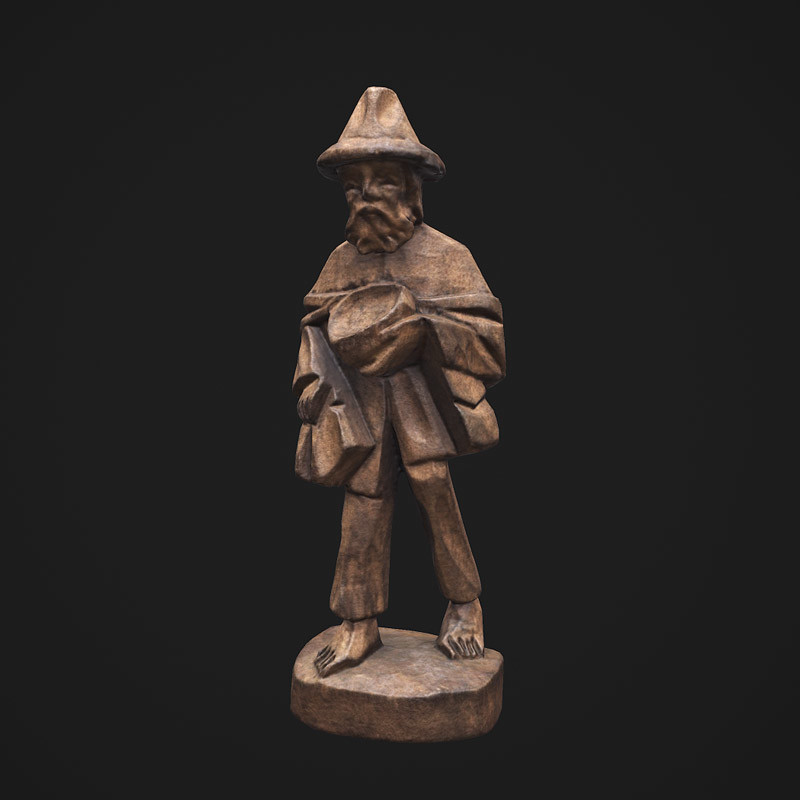
3D Scanning for Cultural Heritage, Art and Special Objects
Some objects cannot easily be replaced. Heritage pieces, artworks, archaeological objects or unique items that, because of their age, fragility or value, need to be handled with great care.
We work with a wide variety of objects, each with its own particular characteristics. Their shape, size, materials and condition all influence how they are scanned and the subsequent work needed to produce a good 3D model.
At Scan3D, we carry out precision 3D scanning of very different types of objects. Every piece has its own characteristics, which means there is no single way to approach its digitisation.
Digitising a piece without losing its details
When working with heritage and art, accuracy is particularly important. The aim is not simply to obtain a model with an approximate representation of the object’s shape, but to capture the characteristics that make it unique.
3D scanning makes it possible to capture the geometry of an object and reproduce its shape and proportions, with the level of detail depending on the object’s characteristics and the scanning technique used. When required, we can also combine textures captured by the scanner with photographs to reproduce its colour and surface appearance.
This is particularly useful for pieces with reliefs, decorative elements, irregularities or shapes that would be difficult to reproduce manually.
Historical, artistic and unique objects
We can work with many different types of objects: archaeological pieces, ceramics, sculptures, decorative objects, artworks, collection pieces and other items that require accurate digitisation because of their particular characteristics.
There are also cases where an object is incomplete or made up of several fragments. In these situations, scanning each element separately makes it possible to work with the digital models afterwards and explore possible reconstructions.
Before starting, we also need to consider where the object is located and the conditions in which scanning can take place. Some objects can be moved and scanned relatively easily, while others need to be scanned where they are kept, taking into account any restrictions on handling and access.
When an object is made up of fragments
One of the projects where this approach was particularly important was the digitisation of a 13th-century Andalusian ceramic storage jar and its support, originating from excavations at La Cuirassa in Lleida.
For this project, we travelled to the University of Lleida, where we carried out individual 3D scans of the jar’s 56 fragments and its support. The aim was to obtain an accurate digital record of each element so that the pieces could subsequently be worked with virtually.
Using the 3D models of the fragments, it was possible to digitally fit the different pieces together and virtually recover the shape of the jar.
In a case like this, the 3D model is more than a visual representation. It also makes it possible to study how the fragments fit together, examine their shapes and explore a possible virtual reconstruction without having to handle the original pieces repeatedly.
The texture is also part of the piece
For some objects, geometry is only part of what needs to be digitally preserved.
The surface may contain colours, patterns, wear, irregularities or different finishes that are part of the object’s identity. In these cases, we also work on capturing and preparing the photographic texture.
One example is a glazed ceramic jug from Puente del Arzobispo. In this project, scanning the shape itself was not particularly complicated, but the glazed surface required greater care when capturing the colour and photographic details because of the reflections from the material.
On surfaces like this, reflections can make it difficult to capture the object’s true colour. This is why it is important to adjust the lighting and, when necessary, combine the information captured by the scanner with photographic images.
What can the 3D model be used for?
A digitised piece can have different uses depending on the purpose of the project.
It can be used for the digital cataloguing of a collection, to document a piece, facilitate its study or provide a digital reproduction that can be examined without having to handle the original object.
It can also be used to create interactive presentations, 3D visualisations, audiovisual material or other digital applications.
When working with fragmented pieces, the digital model can also be used to test reconstruction options or study different possibilities without physically handling the fragments.
A process adapted to each object
Before starting a project, we need to understand how the 3D model will be used and assess the conditions in which scanning will take place. Digitising an object for documentation is not the same as preparing a model for virtual reconstruction or an interactive presentation. These differences influence both the scanning process and the work required afterwards.
This part matters. Technology is a tool, but knowing how to use it in each case is what makes it possible to obtain a useful result.
Frequently asked questions about 3D scanning for cultural heritage:
Can a heritage object be scanned without moving it from where it is kept?
Yes. We can travel to the museum, collection or location where the object is kept and carry out the 3D scanning on site. Beforehand, we need to check whether there is enough space to work around the object, what the lighting conditions are like and whether there are any restrictions on access or handling. In some cases, we may need to adapt the scanning process to the object’s conservation requirements.
Can old or fragile objects be scanned without damaging them?
Structured-light 3D scanning allows us to capture an object’s shape without touching its surface or applying any products to make scanning easier. When working with museum objects, any necessary handling is carried out by the staff responsible for their conservation. Before starting, we assess the object’s condition, how accessible it is and the conditions in which we can work. In some cases, this may limit which areas we can scan, but preserving the original object always comes first.
What happens if some parts of an object cannot be scanned?
Some objects have deep cavities, hidden surfaces or areas that are difficult to reach, which cannot always be captured completely. In these cases, we assess what can be scanned and whether some areas can be completed during post-processing. When a section needs to be reconstructed, we distinguish between the geometry captured by the scanner and the parts that have been digitally interpreted, particularly when the model is intended for heritage documentation or research.
Can the 3D model be used to create a physical reproduction of the original object?
Yes. A model created through 3D scanning can be used as a starting point for producing a physical reproduction using 3D printing or other manufacturing techniques. However, depending on its intended purpose, the digital geometry may need some preparation or modification. Making a replica for an exhibition is not the same as producing a piece that needs to fit together with other components. That’s why it’s important to know from the outset how the model will be used.
Do you have a piece you would like to digitise?
If you have a heritage object, a work of art or any other special object you would like to digitise, tell us a little about it and what you need from the 3D scanning process.
We work with museums, organisations and private individuals in Catalonia. With an initial description of the object, a few photographs and an idea of how the 3D model will be used, we can assess how best to approach the project and whether scanning needs to take place where the object is kept.